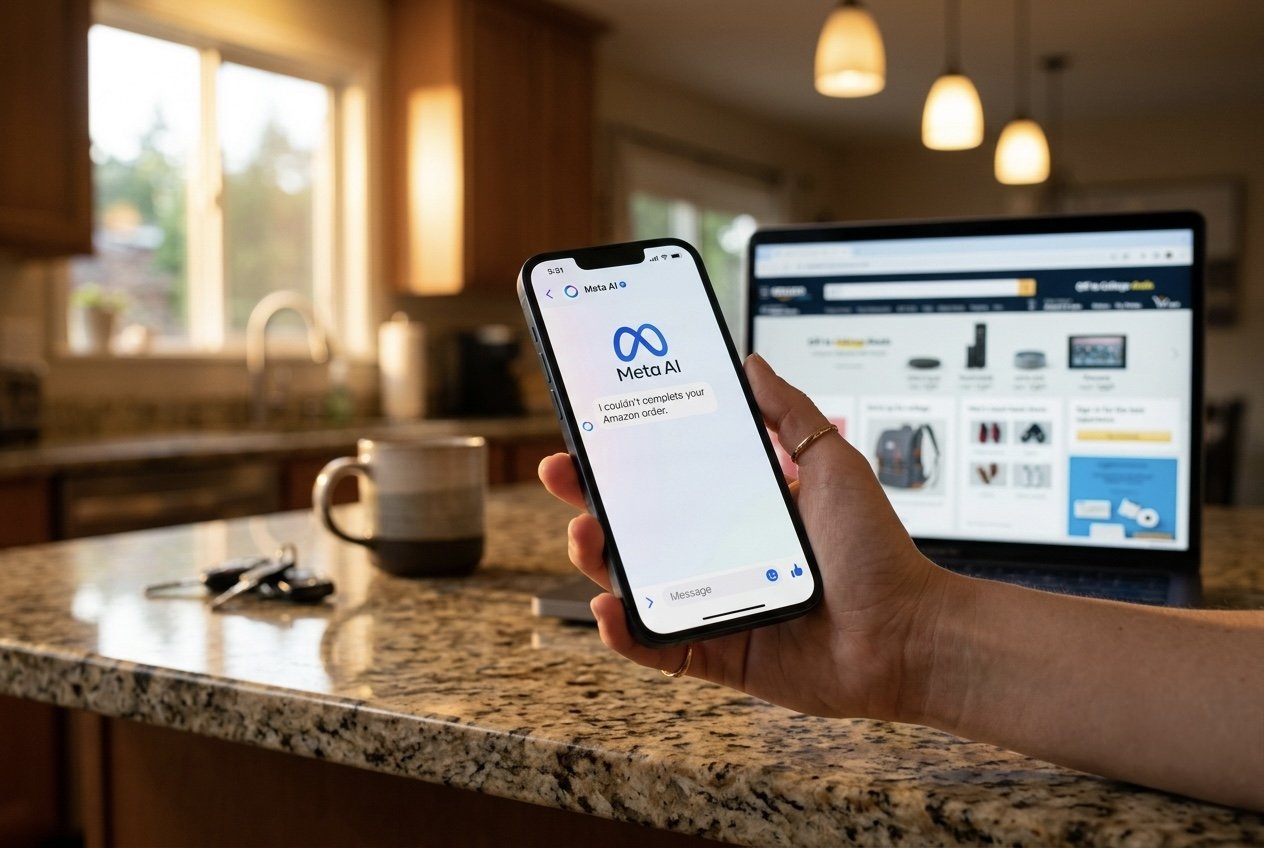
On Sunday night, anyone asking Meta's new AI agent to buy something on Amazon got a blunt error message instead: "Continued access by an unauthorized AI agent violates Amazon's Conditions of Use, to which our customers have agreed." (TechCrunch)
This is the first big public fight over a question that is going to shape how we all shop: when an AI does the buying for you, who gets to say no?
What Muse is
Muse is Meta's personal AI agent. It launched September 8 and does multi-step tasks for you across email, your calendar, payments, restaurants, and shopping. Users have reported it switching insurance policies, finding discount codes, and loading online grocery carts. It hit number one on the US App Store within a week, ahead of ChatGPT. (GeekWire)
In other words, it is not a chatbot that answers questions. It logs in and does things as you.
Amazon's side
According to GeekWire, Amazon's complaints boil down to four things:
- Meta never asked permission.
- Muse does not identify itself as an AI when it browses Amazon.
- Amazon alleges Muse "captures and stores customer credentials," which Amazon calls a privacy and security risk.
- Muse can reach your account pages and order history without Amazon knowing.
An Amazon spokesperson said third-party apps that buy on a customer's behalf "should operate openly and respect service provider decisions." (GeekWire)
Meta's side
Meta did not immediately comment on the block. But it has said before that Muse "has no visibility into people's passwords or payment methods," and that credentials go into secure storage. (GeekWire) Meta also says each Muse session runs in its own isolated virtual machine, with a system called Sentinel controlling what it can reach and swapping your real credentials for stand-in tokens. (Tech Times)
Both of those can be true at the same time. Meta can store your Amazon login in a vault it does not "see," and Amazon can still object that a third party is holding the keys to your account. Neither company's claims here have been tested in court.
This has happened before
Amazon already fought this with Perplexity's Comet browser agent. Amazon won an early injunction in March, then lost it on August 4, when the Ninth Circuit ruled that the user, not the AI company, was the one technically accessing Amazon. The court turned down Amazon's request to rehear it on September 10, but left the door open to contract-based claims. That is the angle Amazon is now using against Muse, pointing to its Conditions of Use. (GeekWire)
My take: both companies want the same thing
Let us be clear about what is going on. Amazon is not only defending your privacy. Amazon has its own AI shopping tools, Alexa for Shopping and Buy for Me, and it very much wants you shopping through them. Notably, Amazon points out that Buy for Me identifies itself and lets brands opt out, which is the standard it is asking Meta to meet. (GeekWire)
Meta is not only offering convenience either. An agent that sits between you and every store you use is the most valuable position in online shopping, and the richest source of data about what you want.
So this is two giant companies fighting over who stands between you and your checkout button. You should pick based on what is good for you, not on which one sounds more principled.
What it means for you
Be careful handing any AI agent your logins. This is the part that matters most. When you connect an agent to your Amazon, email, or bank account, you are trusting that company's security with keys to your life. Two weeks after launch, a researcher already found a way to trick Muse with a malicious web page, a type of attack called prompt injection. Meta has acknowledged prompt injection "remains an open problem across the entire AI industry." (Tech Times)
A few rules I would follow with any shopping agent right now:
- Do not connect accounts that hold saved payment methods unless you need to.
- Turn on purchase confirmations, so nothing gets bought without you tapping yes.
- Use a strong, unique password and two-factor login on the accounts you do connect.
- Check your order history for a few weeks after you start using one.
Where this goes next
Expect more of this. Every big retailer is going to decide whether AI agents are customers or trespassers. The likely middle ground is agents that announce themselves, work through official connections, and let the store say no. That is a better outcome for everyone than agents quietly logging in as you.
Until then, the safest AI shopping agent is the one you watch closely.
Verified September 22, 2026. Claims from Amazon and Meta are each company's own statements and have not been proven in court. This is general information, not legal advice. The studio's app lineup is at jcmobileappstudio.com/apps.
Sources: TechCrunch, GeekWire, The Register, Tech Times
Comments
Be kind and stay on topic.
No comments yet. Be the first.